Guides · how many calories are in a cup of cooked pasta vs dry pasta
How many calories are in pasta, cooked vs dry?
 371 → 158/100g
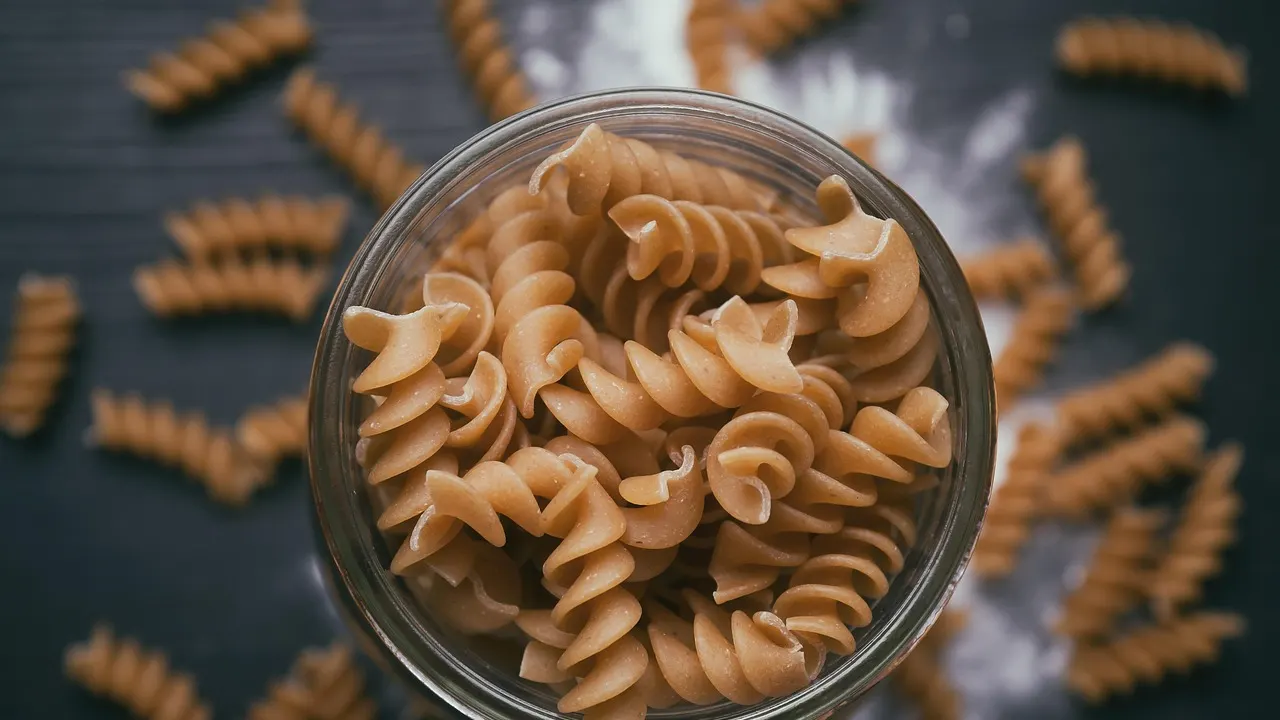
Dry, white pasta is about ≈371 calories per 100 g. Cooked, the same pasta drops to about ≈158 per 100 g. Nothing was lost. It absorbed water and got heavier, so the same energy is spread over more grams.
The numbers
USDA FoodData Central carries separate entries for dry and cooked pasta. Dry, enriched pasta is about ≈371 calories per 100 g, with about ≈13 g protein, ≈1.5 g fat and ≈75 g carbohydrate. Cooked without added salt, it is about ≈158 calories per 100 g, with about ≈5.8 g protein, ≈0.9 g fat and ≈31 g carbohydrate. Whole-wheat pasta follows the same shape: about ≈352 per 100 g dry, about ≈149 cooked.
| Pasta | Dry, per 100g | Cooked, per 100g |
|---|---|---|
| White, enriched | ≈371 cal | ≈158 cal |
| Whole-wheat | ≈352 cal | ≈149 cal |
Why the drop is so big
Raw pasta is mostly starch with very little water. Boiling drives water into it, the way rice or dried beans swell in a pot. The USDA figures show roughly how much: dividing the dry calorie figure by the cooked one gives about 2.35 for white pasta and about 2.36 for whole-wheat. In practice, that means a given weight of dry pasta turns into a bit more than double that weight once it is cooked, for both kinds. The calories stay the same; the grams they are spread across roughly double.
The FDA's serving size, and why it does not line up exactly
The FDA sets an official reference amount for plain pasta under 21 CFR 101.12: 55 g dry, or 140 g once prepared. Run those through the USDA figures above and they almost, but not quite, agree. Using the ≈371-per-100g dry figure, 55 g dry pasta is about ≈204 calories. Using the ≈158-per-100g cooked figure, 140 g cooked pasta is about ≈221. That is a gap of about ≈17 calories on the same "one serving."
That gap is normal, not a mistake. The FDA's 55g-to-140g conversion comes from national survey data on how much people actually eat, not from testing the exact same batch of pasta twice. Real pasta swells by a slightly different amount depending on the shape, the boil time and how well it is drained. Treat both numbers as honest estimates, not a precise before-and-after of one pot of pasta.
Cup vs gram: where trackers go wrong
A "cup" of pasta is not one fixed weight, and this is where most calorie counts quietly go wrong. USDA's own portion data for dry white pasta lists 1 cup of spaghetti at about ≈91 g (about ≈338 calories) but 1 cup of elbow macaroni at about ≈122 g (about ≈453 calories) — same cup, same dry pasta, a third more calories just from the shape. Cooked pasta has the same problem, plus how hard you pack the cup: a loosely filled cup of cooked spaghetti is about ≈124 g (about ≈196 calories), a tightly packed one about ≈151 g (about ≈239 calories).
A kitchen scale does not have this problem. Weighing in grams removes both the shape issue and the packing issue, whether you weigh the pasta dry, before it touches water, or cooked and drained.
Common mistakes
- Logging a cooked, drained weight against a dry-calorie number. A dry-pasta calorie figure applied to a cooked weight undercounts the pasta on the plate by close to half, because cooked pasta is mostly absorbed water.
- Treating "1 cup" as one fixed number. As the USDA data above shows, the cup can mean very different weights depending on shape and how packed it is.
- Assuming whole-wheat pasta is a big calorie cut. USDA's figures put it only about 6% lower than regular pasta once cooked. The real gain is fiber, not a lighter calorie count.
What to do instead
- Pick dry or cooked, and stick with it. Weighing dry pasta before cooking is usually the steadiest method, since cooked weight can shift with the pot, the boil time and the drain.
- Use grams, not cups, especially for dry pasta, where shape alone can swing a "cup" by a third. See pasta and whole-wheat pasta for the full USDA breakdown by weight and shape.
- Choose whole-wheat for the fiber, not the calorie cut. Harvard's Healthy Eating Plate guidance lists whole-wheat pasta among the whole grains it recommends for a milder effect on blood sugar, which is a better reason to switch than chasing a small calorie difference.
- Check how pasta fits your day with the macro calculator, and see how chicken breast changes with cooking for the same water-loss logic in a different food.
Quick answers
how many calories are in a cup of cooked pasta
About ≈196 for a loosely filled cup of cooked spaghetti (124g), using USDA's ≈158-per-100g cooked figure. A tightly packed cup (151g) is closer to ≈239, so the shape and packing matter as much as the cup itself.
how many calories are in 2 oz of dry pasta
About ≈211, from USDA's 2 oz (57g) dry portion and its ≈371-per-100g dry figure. That is close to the FDA's official reference amount for plain pasta, 55g dry, about ≈204 calories.
is whole-wheat pasta much lower in calories than regular pasta
Only a little. USDA lists cooked whole-wheat pasta at about ≈149 calories per 100g against about ≈158 for regular, roughly 6% less. The bigger difference is fiber: about ≈3.9g per 100g cooked versus about ≈1.8g.
should I weigh pasta dry or cooked for tracking calories
Either works if you stay consistent. Weighing dry pasta before it touches water is usually more reliable, because cooked weight shifts with pot size, boil time and how well you drain it.
Sources
- USDA FoodData Central, SR Legacy: Pasta, dry, enriched (FDC ID 169736)
- USDA FoodData Central, SR Legacy: Pasta, cooked, enriched, without added salt (FDC ID 169737)
- USDA FoodData Central, SR Legacy: Pasta, whole-wheat, dry (FDC ID 169738)
- USDA FoodData Central, SR Legacy: Pasta, whole-wheat, cooked (FDC ID 168910)
- US FDA / govinfo, 21 CFR 101.12, Table 2: Reference amounts customarily consumed
- Harvard T.H. Chan School of Public Health, The Nutrition Source: Healthy Eating Plate
General information, not medical advice. Calorie figures are estimates and vary by person.
Keep reading
- how many calories are in oatmeal dry oats vs cookedHow many calories are in oatmeal, dry vs cooked?Dry oats are about ≈379 calories per 100g; cooked in water, that drops to about ≈71. The weight changes, not the energy, here is the math.
- how many calories in a cup of greek yogurtHow many calories in a cup of Greek yogurt?Plain Greek yogurt runs about 59 (nonfat) to 97 (whole milk) calories per 100g, USDA data shows. Unlike regular yogurt, it has no single USDA cup weight.
- how many calories are in chicken breast raw vs cookedHow many calories are in chicken breast, raw vs cooked?Raw chicken breast is about 120 calories per 100 g; cooked (roasted) it is about 165, because cooking drives out water, not energy.