Guides · almond milk vs 2 percent milk
Almond milk vs 2% milk: which has fewer calories?
 15 vs 50 cal/100g
Unsweetened almond milk has about a third the calories of 2% milk, gram for gram, but 2% milk has roughly eight times the protein. USDA figures put almond milk at about ≈15 calories per 100g against about ≈50 for 2% milk. Which one makes sense depends on what you want from the glass.
The numbers, per 100g
USDA weighs both drinks the same way, so the comparison is apples to apples:
| Nutrient | Almond milk, unsweetened | 2% milk |
|---|---|---|
| Calories | ≈15 | ≈50 |
| Protein | ≈0.4g | ≈3.3g |
| Fat | ≈1.0g | ≈2.0g |
| Carbohydrates | ≈1.3g | ≈4.8g |
| Sugars | ≈0.8g | ≈5.1g |
| Calcium | ≈184mg | ≈120mg |
Gram for gram, 2% milk has about 3.3 times the calories of unsweetened almond milk. It also has about eight times the protein. The calcium figure runs the other way: this particular fortified almond milk brand actually carries more calcium than the dairy milk.
What a cup of each actually gives you
A standard cup is heavier for almond milk than for milk. USDA lists 262g for a cup of almond milk and 244g for a cup of 2% milk. Scaled up, that's about ≈39 calories and ≈1g of protein for the almond milk. It's about ≈122 calories and ≈8g of protein for the 2% milk. Swap a daily cup of milk for unsweetened almond milk in your coffee for a week and you save roughly ≈580 calories. You also give up about 49g of protein over that week, close to a day's intake for some adults. The protein calculator gives a rough daily target to compare that against.
Why unsweetened almond milk is so light
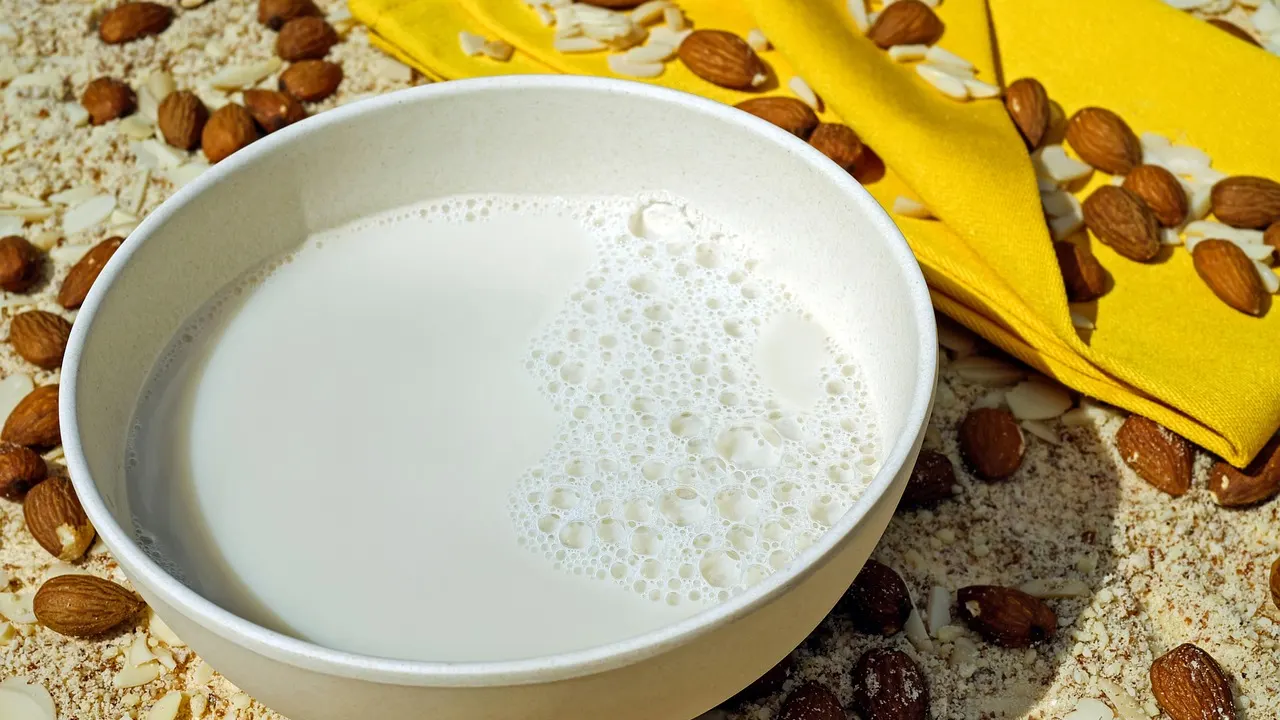
Almond milk is a water extract of almonds, strained to remove the ground pulp. Most of the almond's natural fat and protein stay behind in that pulp. What ends up in the carton is mostly water with a trace of almond. 2% milk keeps nearly everything from the cow: its protein, minerals and natural sugar, lactose. Only some of the fat is skimmed off. That's why 2% milk still carries about ≈5.1g of sugar per 100g. Unsweetened almond milk has almost none, about ≈0.8g.
What a lab analysis of 29 milks found
A 2022 study in Frontiers in Nutrition bought 27 plant-based drinks across 8 categories, plus 2 cow's milk samples, from Swiss retailers. It measured their nutrients directly in the lab. Cow's milk protein came out close to the USDA figure above. Almond drinks averaged about ≈1.0g protein per 100g, more than twice the single USDA brand used in this guide. That gap is a reminder that almond milk formulas differ a lot between brands. Soy drinks came closest to matching milk's protein in that analysis. The researchers' conclusion: replacing milk with a plant drink, without adjusting the rest of your diet, can leave gaps that a single swap doesn't fix.
The label can flip this comparison
"Almond milk" is not one fixed product, and the calorie gap above only holds for the plain, unsweetened kind. USDA figures for a sweetened, vanilla-flavored almond milk show about ≈16 calories per 100g, close to unsweetened. That brand is only lightly sweetened, so the calories barely move. But its sugar more than triples to about ≈2.6g per 100g. Its calcium drops to about ≈78mg per 100g, less than half the unsweetened brand's ≈184mg. A vanilla or chocolate carton on a different shelf can look nothing like the plain one next to it, in both directions.
What to do instead
- Read the calcium and protein lines on the label, not just the calorie count — fortification and protein content vary widely by brand, as both the USDA figures and the Swiss lab analysis show.
- Choose unsweetened, fortified almond milk if you want the lowest calories and still want calcium, and treat flavored versions as a different product nutritionally.
- Keep a dairy or soy source of protein elsewhere in your day if you switch to almond milk, since it will not replace milk's protein on its own. The guide to how much protein you need is a useful starting point for sizing that gap.
Quick answers
is almond milk healthier than 2 percent milk
It depends on your goal. Unsweetened almond milk has about a third the calories and much less saturated fat, but 2% milk has roughly eight times the protein per cup. Neither wins outright.
how many calories are in a cup of almond milk
About ≈39 calories for unsweetened almond milk, using USDA figures for a 262g cup, against about ≈122 for a cup of 2% milk. Sweetened or flavored versions run higher.
does almond milk have more calcium than milk
The USDA brand analyzed here shows about ≈184mg calcium per 100g for unsweetened almond milk, versus about ≈120mg for 2% milk. But fortification varies a lot between brands, so check the label rather than assume.
why is almond milk so low in protein
It is a water extract of almonds, strained to remove the pulp, so most of the nut's protein and fat stay behind. USDA figures show about ≈0.4g protein per 100g, against about ≈3.3g for 2% milk.
Sources
- USDA FoodData Central, SR Legacy: Beverages, almond milk, unsweetened, shelf stable (FDC ID 174832)
- USDA FoodData Central, SR Legacy: Milk, reduced fat, fluid, 2% milkfat, with added vitamin A and vitamin D (FDC ID 171267)
- USDA FoodData Central, SR Legacy: Beverages, almond milk, sweetened, vanilla flavor, ready-to-drink (FDC ID 168751)
- Harvard T.H. Chan School of Public Health, The Nutrition Source: Milk
- Walther B, et al., Comparison of nutritional composition between plant-based drinks and cow's milk, Frontiers in Nutrition, 2022
General information, not medical advice. Calorie figures are estimates and vary by person.
Keep reading
- popcorn vs chips which has fewer caloriesPopcorn vs chips: which has fewer calories?Air-popped popcorn runs about ≈387 calories per 100g, versus ≈532 for potato chips — but a same-size bowl makes the gap far bigger than it looks.
- how many calories are in a hard-boiled egg vs a fried eggHow many calories are in a boiled egg vs a fried egg?A large hard-boiled egg is about ≈78 calories and a fried one about ≈90. The egg barely changes; the fat in the pan is what moves the number.
- how many calories in a cup of greek yogurtHow many calories in a cup of Greek yogurt?Plain Greek yogurt runs about 59 (nonfat) to 97 (whole milk) calories per 100g, USDA data shows. Unlike regular yogurt, it has no single USDA cup weight.