Guides · how many calories are in an orange
How many calories are in an orange?
 ≈62 cal each
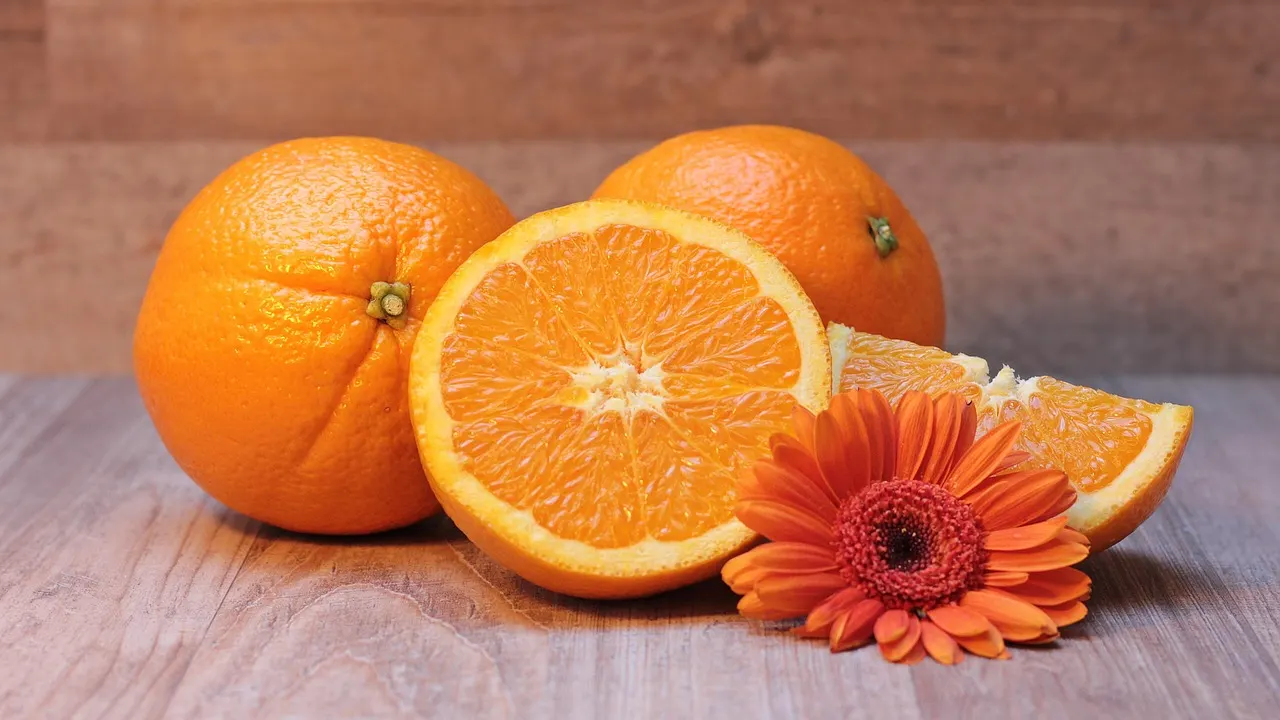
A medium orange is about 62 calories (≈), USDA data shows. But "an orange" is not one fixed size, so the real number for your orange depends on how big it is: about 45 for a small one, about 86 for a large one.
The evidence
USDA FoodData Central lists raw orange at about 47 calories (≈) per 100g. That 100g also carries about 0.9g protein, 11.8g carbohydrate, 2.4g fibre and 9.4g sugar. USDA gives weights for named sizes too, worked out from that same per-100g figure. A small orange (2-3/8 inch across, 96g) is about 45 calories. USDA's "medium" (2-5/8 inch across, 131g) is about 62. A large one (3-1/16 inch across, 184g) is about 86. A cup of peeled sections (180g) is about 85.
Why "an orange" isn't one number
Most pages that answer this question give a single figure, usually 60 to 62. That is a fair estimate for USDA's own "medium" category, but it hides the range. Going from USDA's small to its large size nearly doubles the calories, about 45 up to about 86, with no change in what you are eating, just how big the fruit is. If you eat two oranges a day and they run on the large side rather than the small side, that gap adds up to roughly 80 calories (≈) a day, which is the kind of thing a quick "an orange is about 60 calories" answer does not tell you.
Orange vs. orange juice
Juicing changes the numbers more than most people expect. USDA lists orange juice at about 45 calories (≈) per 100g, close to the whole fruit's 47. But a standard cup of juice (248g) works out to about 112 calories (≈), more than even a large whole orange at about 86. Fibre drops too. USDA lists juice at about 0.2g fibre per 100g, against about 2.4g per 100g for the whole fruit. A medium orange carries roughly 3.1g of fibre (≈); a cup of juice carries roughly 0.5g (≈). Harvard Health Publishing makes the general point directly: whole fruits are good sources of fibre, fruit juices are not. Juice also has more sugar per serving than a piece of whole fruit, because you are drinking the sugar from several oranges at once without the fibre or the chewing that slows you down.
Common mistakes
- Treating "an orange" as one size. USDA's small, medium and large categories are 96g, 131g and 184g, close to double from one end to the other. A quoted "about 60 calories" is only right for the middle of that range.
- Assuming juice and whole fruit match calorie for calorie. By weight they are close (45 vs 47 per 100g), but a cup of juice weighs far more than one orange, so the calories per serving are not close at all.
- Confusing "5 a day" portions with calories. The NHS counts one orange of any size as one fruit portion. That is a fair rule for variety and nutrients, but it is not a calorie rule, since a large orange has nearly double the calories of a small one counted the same way.
What to do instead
- If you are tracking calories closely, weigh the orange or check its size against USDA's small/medium/large diameters rather than assuming one number.
- Choose the whole fruit over juice most of the time. It is harder to overeat by the piece than by the glass, and you keep the fibre.
- See the orange and orange juice pages for the full USDA figures used here, and is fruit sugar as bad as candy sugar? for more on why whole fruit and fruit juice behave differently in the body.
Quick answers
How many calories are in a small orange?
About 45 (≈), USDA data shows, for a small orange (2-3/8 inch across, about 96g). A large one, 3-1/16 inches across, is about 86.
How many calories are in a cup of orange segments?
About 85 (≈), USDA data shows, for a 180g cup. That is close to a large whole orange, since segments keep the fibre a whole orange has.
Does orange juice have fewer calories than a whole orange?
No. A cup of juice (248g) is about 112 calories (≈), more than even a large whole orange, and it has almost none of the fibre, USDA data and Harvard Health both show.
Does the size of an orange matter for your '5 a day'?
Not for counting portions. The NHS counts one orange, any size, as one portion. It does matter for calories, since a large orange has almost twice the calories of a small one.
Sources
General information, not medical advice. Calorie figures are estimates and vary by person.
Keep reading
- how many calories are in honey vs sugar per teaspoonHow many calories are in honey vs sugar per teaspoon?A teaspoon of honey has about ≈21 calories, sugar about ≈16, and maple syrup about ≈17, per USDA data, because honey is a denser liquid.
- calorie counting orange recipeHow to count calories in an orange recipeAn orange recipe has no single calorie count: USDA data puts flesh at about ≈47 cal per 100g, juice at ≈45, and peel at about ≈97 — nearly double.
- how many calories are in oatmeal dry oats vs cookedHow many calories are in oatmeal, dry vs cooked?Dry oats are about ≈379 calories per 100g; cooked in water, that drops to about ≈71. The weight changes, not the energy, here is the math.