Guides · how many calories are in honey vs sugar per teaspoon
How many calories are in honey vs sugar per teaspoon?
 21 vs 16 cal
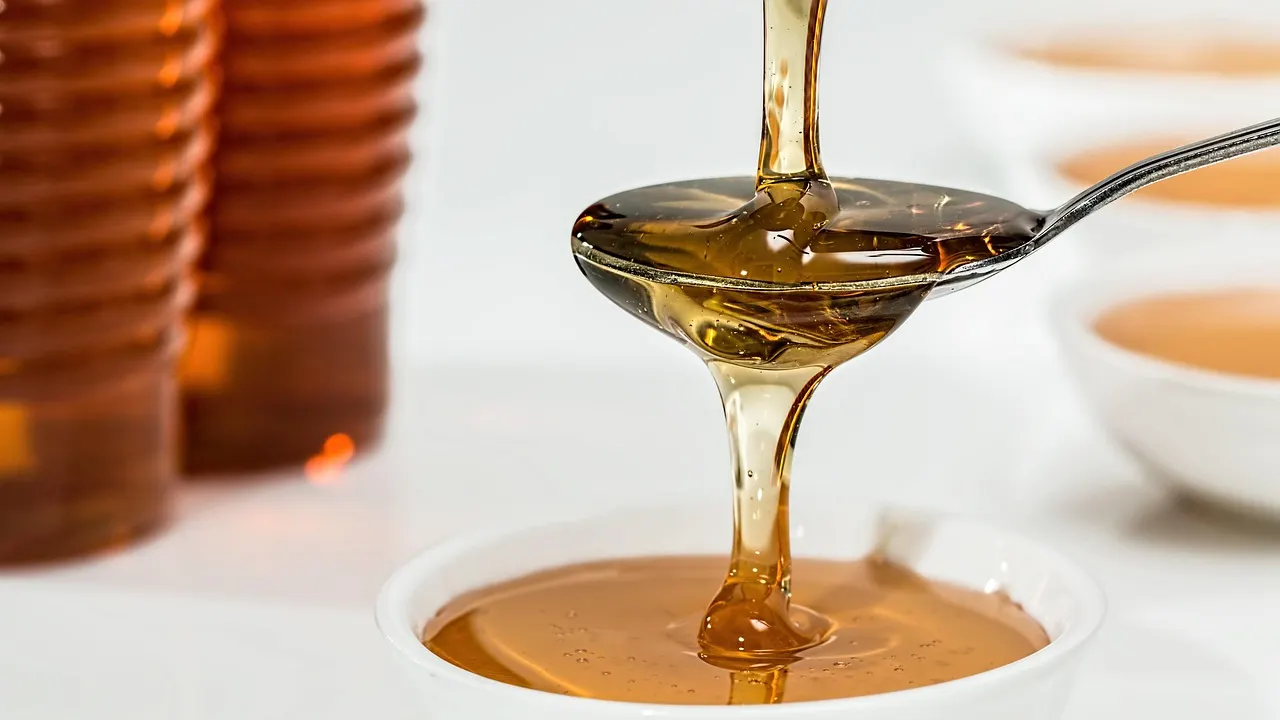
A level teaspoon of honey has about ≈21 calories. The same teaspoon of granulated sugar has about ≈16, and maple syrup about ≈17. Honey has more because it's a dense liquid: a teaspoon of it weighs more than a teaspoon of dry sugar crystals.
The evidence
USDA FoodData Central lab-tests all three sweeteners by weight. Honey comes in at about 304 calories per 100 g, granulated sugar about 387, and maple syrup about 260. These are analytical averages from food samples, not a clinical study, so treat them as sound typical values rather than an exact count for the jar in your cupboard.
USDA's data also lists spoon weights: a tablespoon of honey is 21 g, a tablespoon of maple syrup is 20 g, and a teaspoon of granulated sugar is 4.2 g. Scaled to a level teaspoon, that puts honey at about 7 g and maple syrup at about 6.7 g, against sugar's 4.2 g. A dense liquid simply packs more mass into the same small spoon than loose crystals do.
Why the ranking flips at the spoon
Per 100 g, the way labels are built, sugar is the most calorie-dense of the three, because it holds almost no water. Honey is a little over 80% sugars with the rest water, which dilutes its calories per gram, and maple syrup is thinner still. But nobody measures a coffee sweetener by the 100 g; they measure it by the spoon, and a spoon is a volume, not a weight. A thick liquid fills that volume with more mass than crystals with air gaps between them. That is why, teaspoon for teaspoon, honey (≈21) beats maple syrup (≈17), which beats sugar (≈16) — the exact reverse of their order per 100 g.
What it means in practice
Say you take two teaspoons of sweetener in your coffee, once a day, for a week: 14 teaspoons. With sugar, that is about ≈224 calories (14 × 16). With maple syrup, about ≈238. With honey, about ≈294. The honey habit costs roughly ≈70 more calories a week than the sugar habit, for the same number of spoonfuls. Small, but real, and it compounds over months.
The mismatch also matters for tracking added sugar. Harvard's Nutrition Source notes that the teaspoon figures used in US dietary guidance are built on sugar's own density: 4 g of sugar equals 1 teaspoon. The Dietary Guidelines for Americans cap added sugar at about 12 teaspoons (50 g) a day on a 2,000-calorie diet, and the American Heart Association suggests about 6 teaspoons (24 g) for most women and 9 (36 g) for most men, per Harvard's summary. Those gram limits assume sugar's teaspoon. Swap in honey and 6 "teaspoons" is actually close to 42 g — well past the 24 g the women's figure is built around — even though it still looks like six spoonfuls in your coffee.
Where maple syrup and "natural" sugars fit
The CDC defines added sugars to explicitly include "sugars from syrups and honey," not just table sugar. Your body doesn't treat them differently either way. Cleveland Clinic's dietitian guidance calls honey "still liquid sugar," noting it brings some antioxidants and a lower glycemic index than table sugar, but states plainly that it belongs in the same moderation category as any other added sugar. None of that changes the plain calorie count: a spoonful is a spoonful, and honey's is the biggest of the three.
Common mistakes
- Assuming "natural" means fewer calories. Per teaspoon, honey has more calories than table sugar, not fewer.
- Comparing sweeteners per 100 g instead of per spoon. Labels use 100 g; your kitchen and coffee cup use teaspoons, and the two can rank sweeteners in opposite orders.
- Treating a "teaspoon" of added sugar in official guidance as the same across sweeteners. It's calibrated to sugar's own weight, so a honey teaspoon eats into that limit faster.
What to do instead
- If you're counting calories closely, measure sweeteners by weight on a kitchen scale rather than by spoon; it removes the guesswork.
- If you're watching added sugar grams against a daily limit, remember a teaspoon of honey or maple syrup adds more grams than a teaspoon of table sugar.
- Compare foods on their own USDA figures rather than assuming "natural" sweeteners are automatically lighter. See honey, sugar and maple syrup for the full USDA breakdown of each.
- For how this plays out with sugar from whole food instead of a spoon, see the fruit sugar vs candy guide.
Quick answers
Is honey lower in calories than sugar?
Per teaspoon, no: honey is about ≈21 calories versus sugar's ≈16 (USDA). Per 100 g, honey is actually lower, about 304 versus 387, because it holds more water. Which number matters depends on whether you measure by spoon or by weight.
Is maple syrup lower in calories than honey?
Yes, on both measures USDA lists. Per teaspoon it's about ≈17 versus honey's ≈21, and per 100 g it's about 260 versus honey's 304.
Does switching from sugar to honey cut calories?
Not if you use the same number of spoonfuls. A teaspoon of honey weighs more than a teaspoon of sugar, so it carries more calories, not fewer.
Why do nutrition labels and recipes disagree on which sweetener has more calories?
Labels report calories per 100 g, where sugar wins for being driest. Recipes and coffee cups use spoons, a measure of volume, where dense honey packs in more weight and more calories.
Sources
- USDA FoodData Central, SR Legacy: Honey (FDC ID 169640)
- USDA FoodData Central, SR Legacy: Sugars, granulated (FDC ID 169655)
- USDA FoodData Central, SR Legacy: Syrups, maple (FDC ID 169661)
- Harvard T.H. Chan School of Public Health, The Nutrition Source: Added Sugar in the Diet
- CDC: Added Sugars
- Cleveland Clinic: The Benefits of Honey — How to Incorporate It Into Your Diet
General information, not medical advice. Calorie figures are estimates and vary by person.
Keep reading
- how many calories are in an orangeHow many calories are in an orange?A medium orange is about 62 calories, USDA data shows, but size swings it from about 45 small to 86 large. A cup of orange juice runs about 112.
- how many calories are in common foods per 100 gramsCalories in 40 common foods per 100 g, rankedWe ranked 40 common foods by calories per 100 g with USDA data. The spread is about 60-fold, and water content explains most of it. Free CSV included.
- how many calories are in oatmeal dry oats vs cookedHow many calories are in oatmeal, dry vs cooked?Dry oats are about ≈379 calories per 100g; cooked in water, that drops to about ≈71. The weight changes, not the energy, here is the math.