Guides · calorie counting orange recipe
How to count calories in an orange recipe
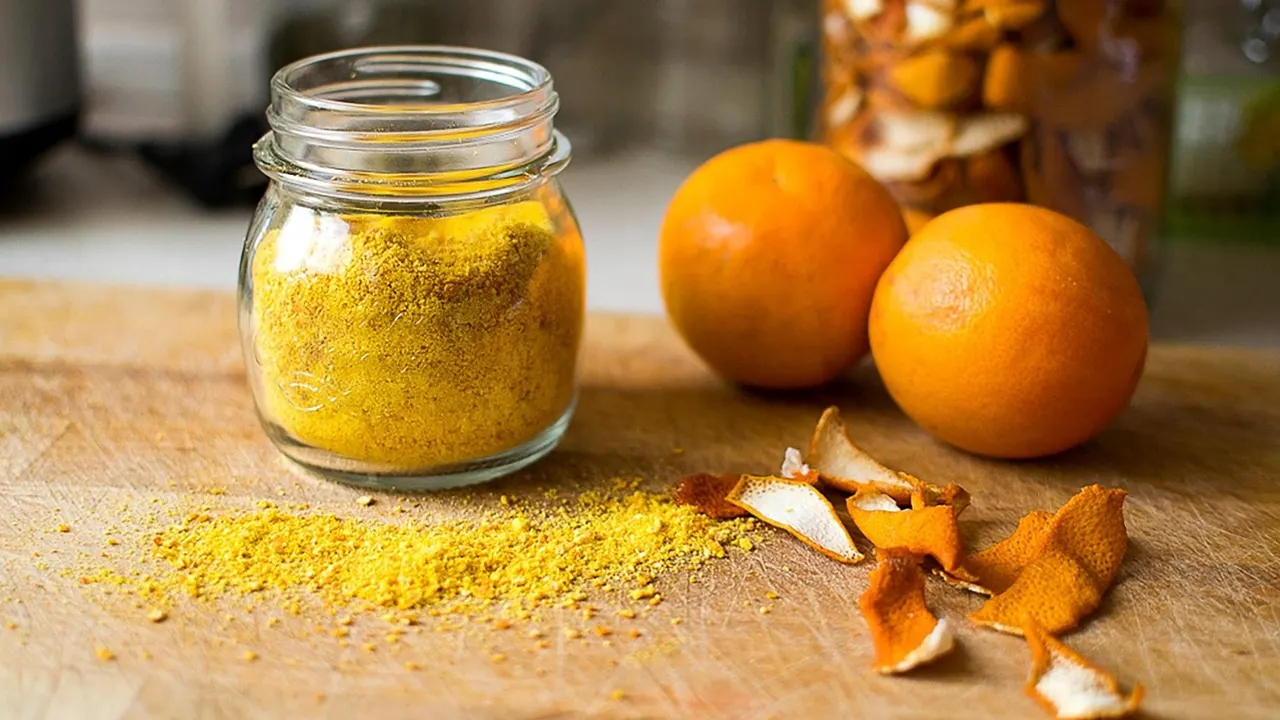 97 vs 47 cal/100g
There is no single calorie count for "an orange recipe," because oranges aren't one ingredient. Flesh, juice and peel each have a different calorie density, so the number depends on which parts your recipe actually uses.
The evidence
USDA FoodData Central lists raw orange flesh at about 47 calories (≈) per 100g. Size-based weights run about 96g (small), 131g (medium) and 184g (large), a near-doubling from smallest to largest. Orange juice is close on a per-100g basis, about 45 calories (≈), with a standard cup (248g) at about 112 (≈). Orange peel is a different story. USDA lists it at about 97 calories (≈) per 100g, roughly double the flesh. The peel's own numbers explain why: it carries about 25g carbohydrate per 100g, against about 12g for the flesh, once the water-heavy pulp is gone. The FDA's menu-labeling rules let restaurants build calorie numbers from a nutrient database or a calculation rather than a lab test. They must account for the "natural variation of foods," which is exactly the kind of size swing USDA's own small-to-large range shows.
Why "an orange" isn't one ingredient in a recipe
A recipe can call for an orange's zest (peel), its juice, its whole segments, or some mix of the three, and they are not close. Zest is only ever used in small amounts, so its high per-100g figure (≈97) rarely adds much in absolute terms. Juice and flesh are close by weight (≈45 vs ≈47 per 100g), but a recipe or drink often uses far more juice by weight than you'd eat as segments, so a cup of juice can contribute more calories than a serving of fruit.
What it means in practice
Take a simple orange and olive salad: segments from two medium oranges (2 x 131g = 262g) plus a one-fluid-ounce drizzle of the squeezed juice (31g), serving four. At about 47 calories (≈) per 100g, the segments come to about 123 calories (≈). At about 45 calories (≈) per 100g, the juice adds about 14 (≈). That is roughly 137 calories (≈) total, or about 34 (≈) per serving. Now swap those "medium" oranges for "large" ones (184g each). Nothing else changes, but the segment total alone rises to about 173 calories (≈). That is roughly 50 more calories (≈) from fruit size alone, over a third of the original total. This is the "natural variation" the FDA's guidance points to. It is bigger than most people assume.
Why two recipes can show different numbers for the same dish
Online recipe calorie counts are typically self-reported, the same way a nutrition label is. Harvard Health Publishing notes that many recipes published online, in cookbooks and in magazines give calorie information just like packaged food does. But unlike a package, nobody tests the finished dish in a lab. The FDA's menu-labeling rules show what "reasonable" looks like, even for professional kitchens: a database lookup or a calculation, divided by the servings the preparer says the dish makes. Every step carries an assumption. That includes the size of orange used, how much zest or juice went in, and how many pieces the dish was actually cut into. Change any of those and the honest number changes with it, even though nothing went wrong.
Common mistakes
- Treating "an orange" as one ingredient. Flesh, juice and peel have different calorie densities; a recipe's note of "1 orange, zested and juiced" uses parts with different numbers.
- Ignoring size. USDA's small-to-large range runs from 96g to 184g, close to a two-fold difference in calories from the fruit alone.
- Assuming a recipe site's per-serving figure is measured, not calculated. The FDA accepts calculations and database lookups as a reasonable basis for restaurants; home recipe sites use the same approach, with no requirement for lab testing.
- Forgetting the servings divisor. A total calorie count split into fewer, larger servings than the recipe assumed will understate what you actually ate.
What to do instead
- Weigh the oranges you actually use, or check them against USDA's small, medium and large diameters, rather than assuming one flat number.
- Separate the parts in your head: zest for flavour (small calorie add), juice for volume (can add up fast), segments for the bulk of the fruit's calories.
- Count the servings you actually cut, not the number the recipe lists, if you divided the dish differently.
- For the full USDA numbers on the fruit itself, see how many calories are in an orange?.
Quick answers
How many calories are in orange zest?
USDA lists orange peel at about 97 calories (≈) per 100g, almost double raw orange flesh's ≈47. But zest is used in such small amounts, a teaspoon or two, that it adds only a few calories to most recipes.
Does orange juice have the same calories as orange flesh?
Almost, per 100g: USDA lists juice at about 45 calories (≈) versus about 47 (≈) for flesh. But a cup of juice weighs 248g, far more than a single orange (96-184g), so a full cup (≈112 calories) usually adds more than the fruit it came from.
Why do two orange recipes online show different calorie counts for a similar dish?
The numbers are usually calculated from a database, not measured in a lab, and depend on assumptions like orange size, how much zest or juice was used, and how many servings the dish was divided into. Those assumptions vary recipe to recipe.
Does the size of the orange in a recipe matter for calories?
Yes. USDA's weights run from about 96g for a small orange to about 184g for a large one, which is close to double the calories from the fruit alone, a bigger swing than most recipes account for.
Sources
- USDA FoodData Central: Oranges, raw, all commercial varieties (FDC ID 169097)
- USDA FoodData Central: Orange juice, raw (FDC ID 169098)
- USDA FoodData Central: Orange peel, raw (FDC ID 169103)
- US FDA: Guidance for Industry, Menu Labeling Supplemental Guidance
- Harvard Health Publishing: Calorie counting made easy
General information, not medical advice. Calorie figures are estimates and vary by person.
Keep reading
- how many calories are in an orangeHow many calories are in an orange?A medium orange is about 62 calories, USDA data shows, but size swings it from about 45 small to 86 large. A cup of orange juice runs about 112.
- what are calories in foodWhat is a calorie, and why do foods vary so much?A calorie is a unit of energy. Protein and carbs give about 4 calories per gram, fat about 9, and alcohol about 7, which is why foods vary so much.
- almond milk vs 2 percent milkAlmond milk vs 2% milk: which has fewer calories?Unsweetened almond milk runs about ≈15 calories per 100g versus ≈50 for 2% milk, but 2% milk has about eight times the protein — the full trade-off here.